How to improve your EcoVadis score: Interpreting strengths & improvement areas
Last updated: July 7, 2025
Once your EcoVadis assessment is complete, your scorecard does more than just show where you stand—it tells you where to go next. The real power lies in the strengths and improvement areas provided for each sustainability theme. These insights are designed not to critique but to guide, helping you target the right improvements and steadily raise your sustainability performance.
Strengths: Where you’re getting it right
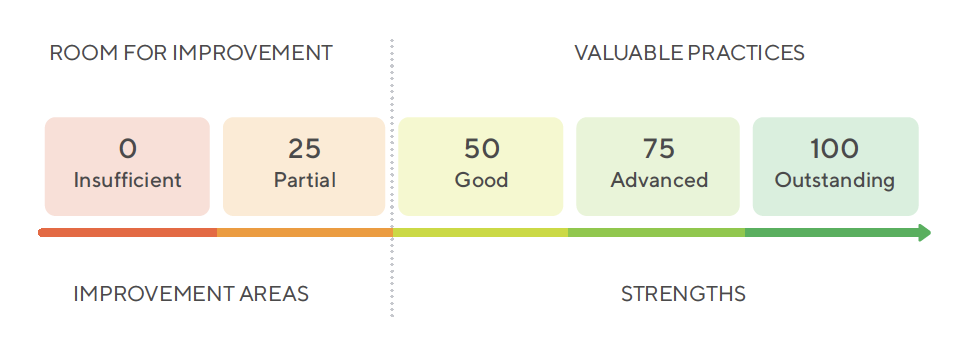
Strengths reflect well-established practices within your sustainability management system. These are areas where your company has demonstrated maturity—whether through clear policies, strong implementation, or robust performance tracking.
But even a strength isn’t the finish line. Strengths exist on a spectrum. A “Good” practice today might be developed into an “Advanced” or “Outstanding” one tomorrow with additional formalization, transparency, or deployment.
Use them to:
Identify what’s working and build on it.
Set internal benchmarks for other business units or regions.
Validate sustainability efforts in communication with customers or investors.
Improvement areas: Your next priorities
Improvement areas highlight specific actions your company can take to boost performance. They’re presented across the same management layers—Policies, Actions, and Results—and tailored to the themes assessed (Environment, Labor & Human Rights, Ethics, and Sustainable Procurement).
These suggestions are not arbitrary. Each improvement area corresponds to expectations tied to your company’s size, industry, and risk exposure. Their priority level (low, medium, or high) indicates how significantly they may affect your score.
Use them to:
Focus on improvements that deliver the biggest impact first.
Build or enhance internal sustainability initiatives.
Structure your Corrective Action Plan for reassessment.
Key clarification
The number of strengths or improvement areas does not determine your score. A company may have only a few high-quality practices and score well. Similarly, addressing a long list of improvement areas doesn’t guarantee a score increase—the quality and relevance of implementation matter most.
How to act on them
Prioritize high-impact themes
Look at which sustainability themes carry the most weight in your assessment (visible in your scorecard) and focus improvement efforts there.
Check supporting documents
Strengths are only credited when backed by acceptable documentation. Revisit your submission to ensure you’ve linked the right documents to each declaration.
Use the Corrective Action Plan (CAP)
EcoVadis provides a CAP feature to help track progress between assessments. As a feature it is meant to also enable collaboration with customers and requesters as a way to prioritize improvements. Upload updated documents here for review in your next cycle.
Review progress regularly
Don’t wait until the next reassessment. Use your improvement areas as checkpoints in your internal sustainability roadmap.
In short
Strengths show what you’re already doing well. Improvement areas tell you exactly where to aim next. Together, they form a practical blueprint for building a more mature, well-rounded sustainability management system.