PPWR supplier guidance for applied substances
Last updated: October 1, 2026
1. What are applied substances?
Applied substances are materials or chemical additions, such as inks, varnishes, lacquers, coatings, glues, adhesives and colourants, that are put onto or into a packaging component, but that are not reported as a separate component themselves.The PPWR does not define the term "applied substances". We use it as one name for all of these materials.
In practice, this means you do not treat "the ink" or "the glue" as a separate component in the packaging bill of materials. You record them on the component they belong to, and what they contain (heavy metals, pigments and other substances) counts towards that component (see section 4).
Typical examples:
Printing ink on a carton, label or flexible film.
Varnish, lacquer or a barrier or functional coating on a paper or plastic surface.
Adhesive or glue that bonds a label, seal or closure to the packaging.
Pigments and dyes that colour a plastic, glass or paper component.
A quick test: if the substance is a layer or ingredient on a component and would not be sold, handled or separated by the user as an item of its own, it is an applied substance. If it can be separated as its own item, such as a removable label, a sleeve or a cap, it is a component and is reported as one.
2. How are applied substances connected to the PPWR?
The PPWR rules on harmful substances apply to everything a packaging unit is made of, including the ink, coating, glue or colour on it. An applied substance is not exempt just because it is only a thin layer. These rules apply to all packaging placed on the EU market from 12 August 2026.
In practice, the PPWR (Article 5) asks for three things:
Keep harmful substances as low as possible → Packaging must be made so that substances of concern (SoC), meaning hazardous substances, are minimised. Inks, coatings and adhesives can contain them.
Stay under the fixed limits → Lead, cadmium, mercury and hexavalent chromium may not exceed 100 mg/kg combined including all applied substances*, and pigments are a common source of these metals. Food-contact packaging also has limits for PFAS, which can be found in grease- or water-repellent coatings.
*Note: The 100 mg/kg limit is a single total for the whole packaging total. That total includes the base material and every applied substance (ink, coating, glue, colourant), rather than a separate limit for each layer.
Be able to prove it → The manufacturer must show compliance in the technical documentation. For applied substances, this data usually has to come from the supplier of the ink, coating or adhesive, and suppliers are required to provide it (Article 16).
3. Why applied substances matter: the link to SoC
Applied substances are the layer of packaging where substances of concern (SoC) are most likely to sit, so any SoC assessment of a component has to include them. The PPWR points to SoC as defined in the ESPR (Regulation (EU) 2024/1781, Article 2(27)). A substance is an SoC if it meets any one of these conditions:
It is on the REACH Candidate List of substances of very high concern (SVCH).
It has a harmonised CLP classification (Annex VI) in hazard classes such as carcinogenicity, mutagenicity, reproductive toxicity, endocrine disruption, PBT/vPvB, sensitisation, aquatic toxicity or specific target organ toxicity.
It is regulated under the POPs Regulation (EU) 2019/1021.
It negatively affects the reuse and recycling of the materials it is present in.
For each applied substance you must collect the following data:
Data to gather | What to record |
Type | Ink, coating, adhesive or colourant |
Component | The packaging component it is on, for example carton, label or film |
Heavy metals | Whether it contains lead, cadmium, mercury or hexavalent chromium, for example in pigments |
PFAS | Whether it contains or may contain PFAS, especially for food-contact packaging |
Evidence (provided once per packaging item) | The supplier declaration or test report that backs this up. For heavy metals, testing to CEN report CR 13695-1 is recommended |
Keep in mind that an applied substance may or may not contain a substance of concern (SoC).
A harmless water-based coating is an applied substance, but it contains no SoC. An ink that includes a REACH Candidate List substance is an applied substance that does contain an SoC.
4. How to record applied substances in the Coolset app
Applied substances are recorded in the PPWR assessment of each packaging item. The steps depend on whether the item has one component or several.
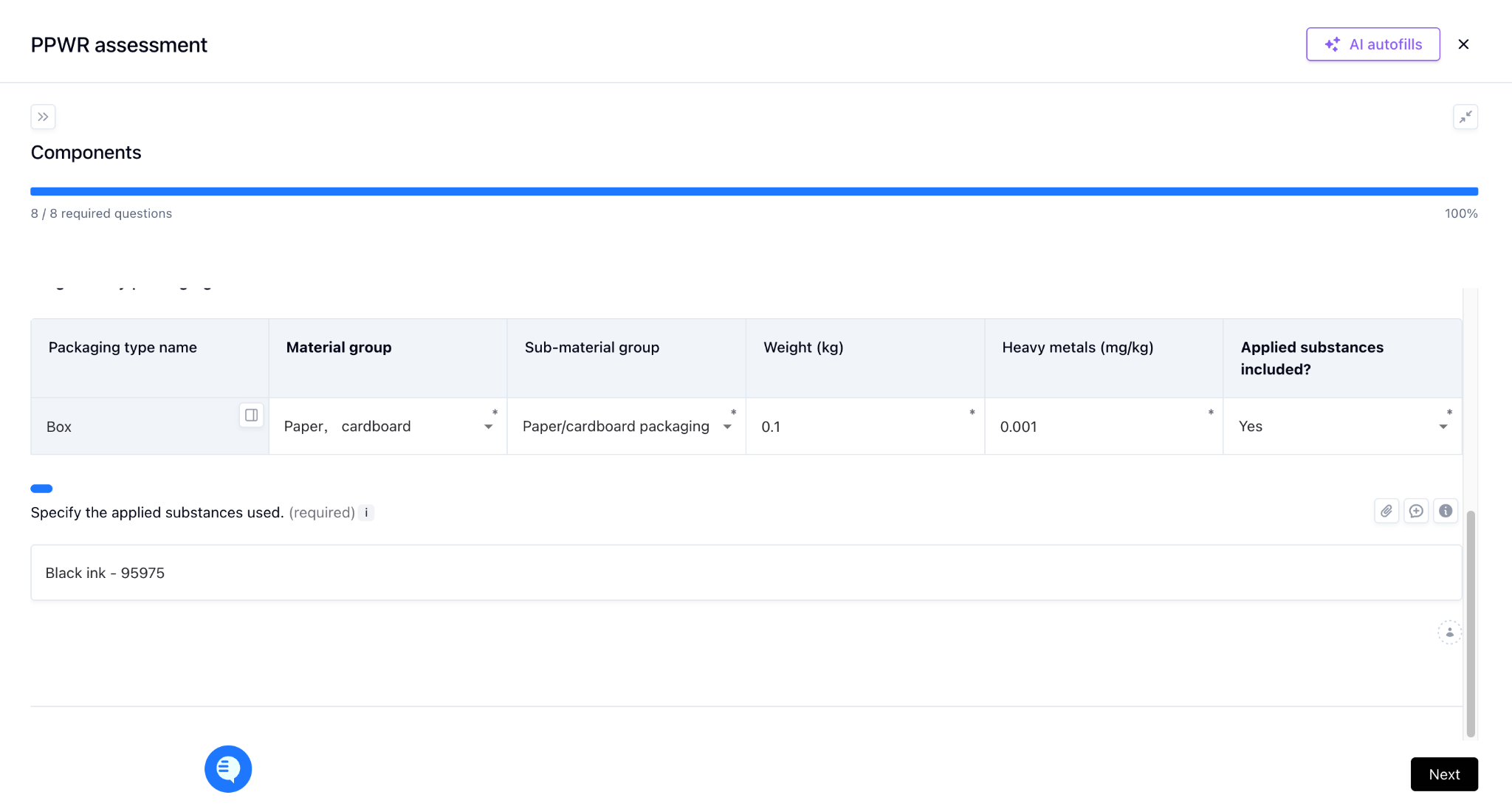
For single component packaging items:
1. In the table, answer the question on if this item includes any applied substances.
2. If yes, name what applied substances.
3. In the total heavy metal concentration, include the concentration of both the packaging item and the applied substance.
For a box with ink printed on it, the heavy metal total covers both the box material and the ink.
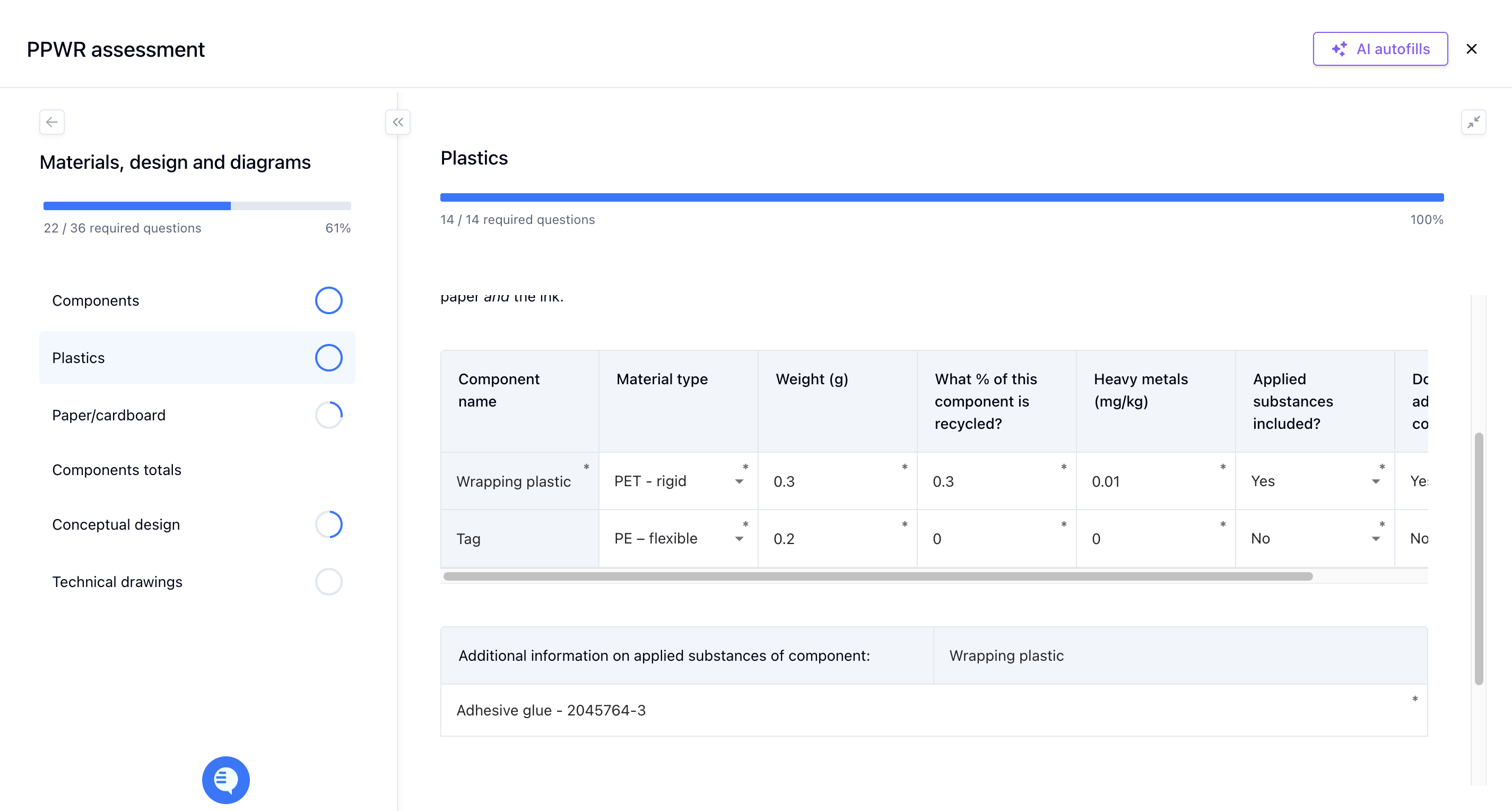
For multi component packaging items:
The components are split per component material, so applied substances are recorded on each component:
For each component answer question on if this component includes any applied substances
If yes, name what applied substances are applied on each component
The total heavy metal concentration includes the concentration of both the packaging item and the applied substance.