How to review an evidence bundle in Coolset
Last updated: September 7, 2026
An evidence bundle is the complete set of technical documentation for a packaging item, exported from Coolset as a downloadable file. Once your supplier has completed the packaging questionnaire, you can download the evidence bundle to review the information and documents they provided. Reviewing it is a mandatory step before signing the Declaration of Conformity (DoC) as the manufacturer, you are legally responsible for confirming that all documentation is accurate and complete before you declare conformity.
How to download an evidence bundle
Go to PPWR in the left navigation menu
Open the product that has the relevant packaging item connected
In the side panel that opens, click Download evidence bundle
Coolset compiles all data entered for that packaging item, including your supplier's questionnaire answers and any documents they attached, into a single downloadable bundle.
What the evidence bundle contains
The evidence bundle contains a PDF file, in this file you'll find the packaging survey.
The evidence bundle reflects the five elements of the technical documentation required under Annex VII of Regulation (EU) 2025/40:
General description — packaging item, materials, dimensions, weight, intended product, and food-contact status
Design and technical drawings — bill of materials per component, layer breakdown including inks and adhesives, conceptual design and structural drawings
Harmonized standards applied — list of standards relied on (e.g. EN 13430:2004), or documented workarounds where no standard exists
Qualitative description of assessments — how the Article 6 (recyclability) and Article 11 (criteria for reusability - only for packaging claimed to be reusable) assessments were carried out
Test reports — uploaded supplier-issued or third-party test results for heavy metals, PFAS, and (from 2030) recycled content
What to check when reviewing
1. Completeness
Every element of the technical documentation must be present and sufficiently detailed to withstand an audit. Check that:
All five Annex VII elements are populated — no blank or placeholder fields
The general description matches the actual packaging (material, weight, dimensions, packaged product)
The component table covers every component, including secondary materials like inks, adhesives, and coatings
Assessment methodology explain how the assessment was done, not just what the conclusion was
If any element is missing or thin, you need to reach out to your supplier and ask them to update the questionnaire and refresh the results.
2. Test reports
Compliance claims must be backed by actual test results, not just supplier statements of conformity. Check that:
A heavy metal concentration test report is present
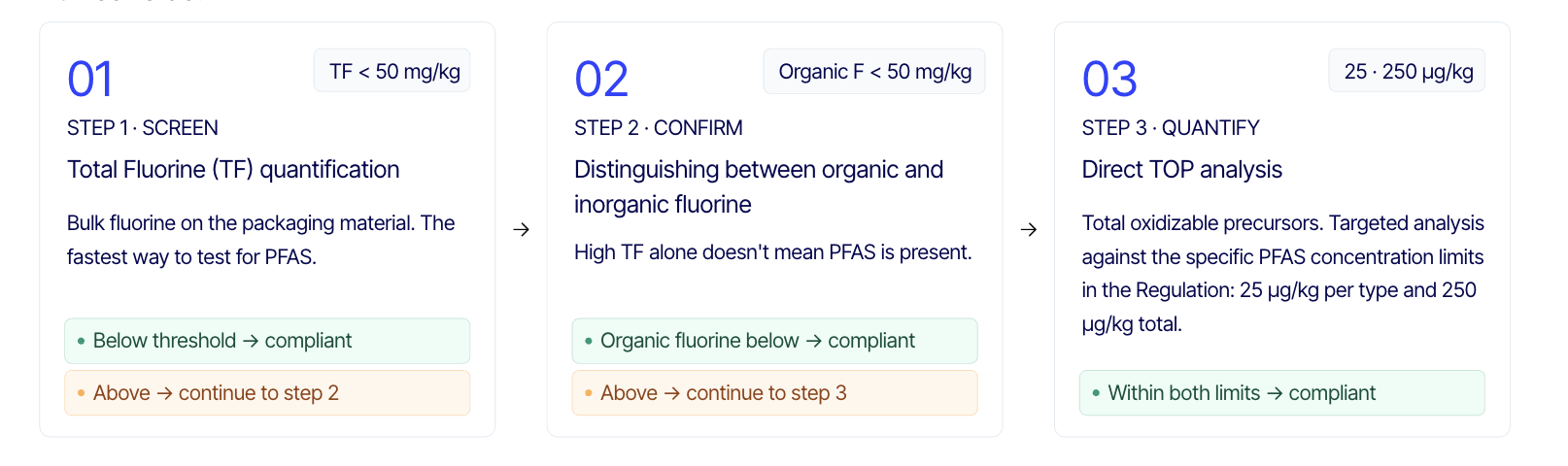
A PFAS test report is present, covering total fluorine, organic fluorine, and direct TOP analysis where required (only for food contact packaging)
Test reports are issued by the supplier or an accredited third party — self-declarations without supporting data are not sufficient
Test reports correspond to the current packaging configuration — reports from a previous supplier or an older material specification are not valid for the current assessment
3. Regulatory references
The technical documentation must reference specific EU regulations and standards, not generic compliance language. Check that:
Harmonized standards are cited by name and number (e.g. EN 13430:2004), not described generically as "EU packaging standards"
Where a harmonized standard was not applied, the workaround or alternative method is explicitly documented and justified
The assessment descriptions reference the correct articles: Article 5, Substance of Concern, Article 6 for recyclability, Article 11 for reusability
The regulation is identified as Regulation (EU) 2025/40 — a generic reference to "EU packaging law" is not sufficient
4. Internal consistency
The documentation must be consistent across all elements. Check that:
The materials listed in the general description match the component table
Test reports cover the materials and substances described in section 2 — a report for a different material grade or a different packaging configuration is not valid
The technical file version is clearly identified so the DoC can reference it precisely (e.g. TF-2026-001 v1)
Common issues to watch for
Missing or generic test reports
A supplier statement saying "this packaging complies with PFAS restrictions" is not a test report. You need the actual test data. If a supplier has not yet provided test results, ask your supplier to update their assessment.
Outdated test reports after a supplier change
If you have switched to a new supplier for the same packaging, test reports from the previous supplier are no longer valid. The new supplier must provide fresh documentation before you can sign a new DoC.
Assessment descriptions that only state the conclusion
"This packaging is recyclable" is not a qualitative description of an assessment. The documentation needs to explain the basis, which standard was applied, what was tested, and what the outcome was. If this is missing, ask your supplier to update the questionnaire responses before downloading the bundle again.
Frequently asked questions
Do I need to review the evidence bundle every time I sign a DoC?
Yes. Each time you sign or re-issue a DoC, you should download and review the current evidence bundle. If the packaging, supplier, or standards have changed since the last signature, the documentation must reflect those changes.Can I share the evidence bundle with my supplier to fill gaps?
The evidence bundle is your export from Coolset. To request missing data from a supplier, reach out to your supplier directly. You can use the files from the evidence bundles in your communication.What if a harmonized standard does not exist for my packaging item?
Document the alternative method or specification you used instead, and explain why no harmonized standard applied. This workaround must be recorded explicitly in the technical documentation, leaving the field blank is not acceptable.What counts as a sufficient test report for PFAS?
The test report must cover total fluorine, organic fluorine, and direct TOP (total oxidizable precursor) analysis. Supplier declarations without underlying analytical data do not satisfy this requirement.