Breakdown of the GHG-protocol categories
Last updated: November 20, 2025
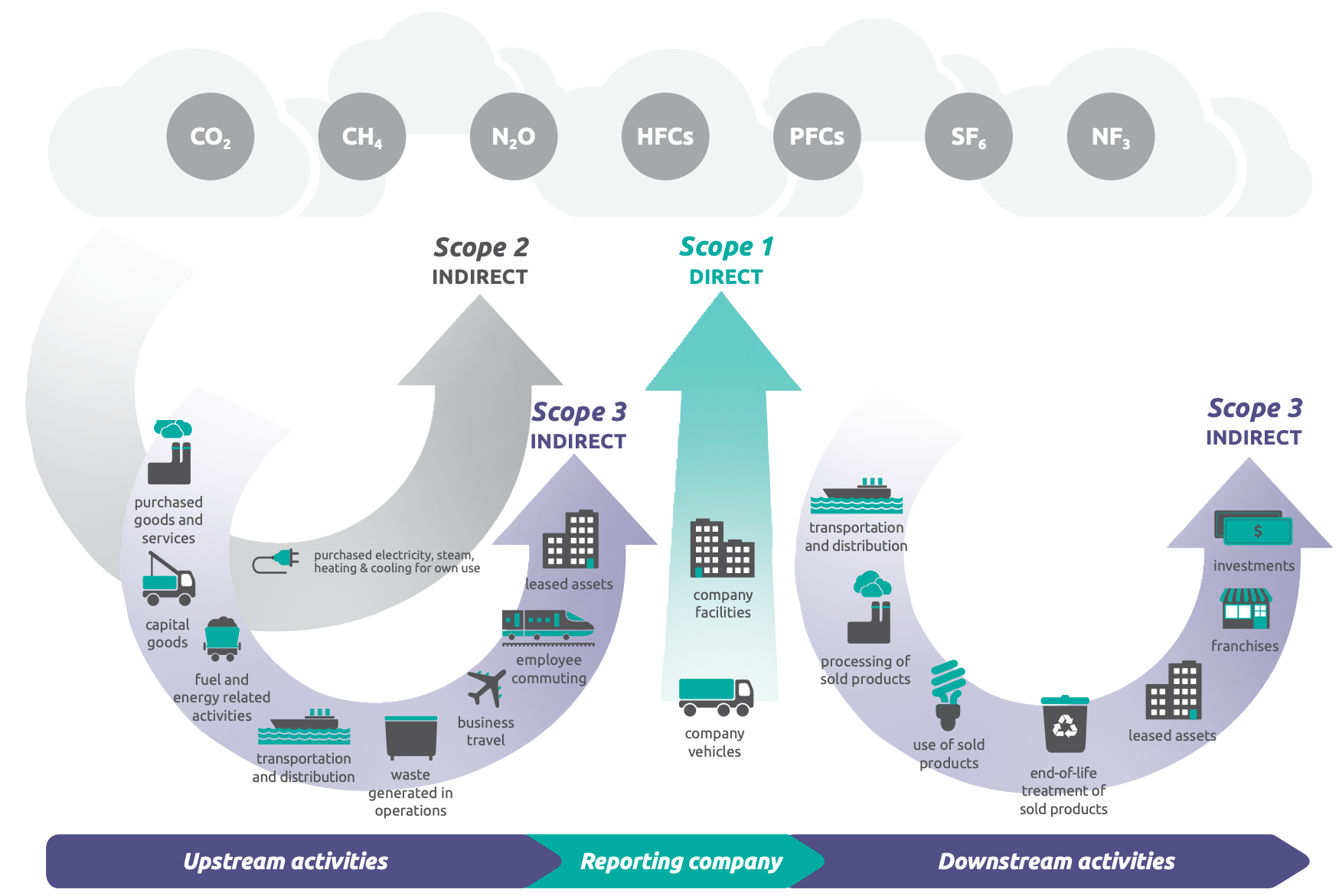
To standardize carbon accounting, Coolset follows the Greenhouse Gas Protocol (GHG protocol), organizing emissions into three scopes:
Scope 1: Direct emissions from owned or controlled sources
Scope 2: Indirect emissions from purchased energy
Scope 3: Indirect emissions from your value chain (both upstream and downstream)
Each scope includes specific categories. Here's a clear breakdown with examples and how emissions are calculated.
Scope 1: Direct emissions
These come from sources your company owns or controls.
Mobile Combustion
What: Fuel burned in company vehicles
Example: Fleet of diesel trucks
How it’s calculated: Liters of fuel × emission factor
Stationary Combustion
What: Fuel used in buildings or equipment
Example: Natural gas for heating
How it’s calculated: Cubic meters × emission factor
Fugitive Emissions
What: Leaks from refrigeration or air conditioning
Example: Refrigerant leakage in supermarkets
How it’s calculated: Leak volume × emission factor
Scope 2: Indirect emissions (from energy use)
These are from purchased energy used in your operations.
Purchased electricity
Example: Grid electricity for offices
How it’s calculated: kWh × emission factor
Heat & steam
Example: District heating in factories
How it’s calculated: MWh × emission factor
Cooling
Example: Data center using external cooling
How it’s calculated: MWh × emission factor
Scope 3: Indirect emissions (from your value chain)
Scope 3 covers 15 categories split into upstream (before you) and downstream (after you).
🔼 Upstream Emissions
Category | Description | Example | Calculation |
3.1 Purchased Goods/Services | Manufacturing of goods/services you buy | Buying office furniture | Spend-based or supplier EF |
3.2 Capital Goods | Emissions from long-term assets | Purchasing a forklift | Spend-based or supplier EF |
3.3 Fuel & Energy-Related | Emissions from producing the energy you buy | Well-to-tank emissions from gasoline | Auto-calculated from Scope 1 & 2 use |
3.4 Upstream Transportation | Shipping goods to you | Raw material transport | Distance × weight × EF |
3.5 Waste in Operations | Waste disposal from your facilities | Landfilling office paper | Weight × waste-type EF |
3.6 Business Travel | Employee travel for work | Flights and hotels | Spend-based or distance × EF |
3.7 Employee Commuting | Daily travel to work | Commuting by car or train | Employees × distance × EF |
3.8 Upstream Leased Assets | Leased assets you operate but don’t own | Rented office space | Energy use × EF |
🔽 Downstream Emissions
Category | Description | Example | Calculation |
3.9 Downstream Transportation | Shipping to customers | Freight to retailers | Distance × weight × EF |
3.10 Processing of Sold Products | Further processing by others | Ingredients refined post-sale | Energy use × EF |
3.11 Use of Sold Products | Emissions from product use | Customers driving sold vehicles | Lifetime use × EF |
3.12 End-of-Life Treatment | Waste disposal of sold goods | Textile waste from apparel | Disposal method × EF |
3.13 Downstream Leased Assets | Assets you own but lease out | Refrigerators leased to events | Energy use × EF |
3.14 Franchises | Emissions from franchisees | Fast food franchises | Operational energy use × EF |
3.15 Investments | Emissions from investments | Funding a construction firm | Operational energy use × EF |