Understanding supply chain traceability systems
Last updated: November 5, 2025
What is supply chain traceability?
Supply chain traceability means being able to track the journey of a product, from its origin (farm, forest, or source) through every stage of processing, transport, and trade, all the way to the final buyer.
A traceability system is the method or methods to follow this product's journey through the supply chain, helping companies know where their materials come from, who handled them, and under what conditions.
Traceability is essential for building trust, ensuring legality, and showing that your products are sustainable and deforestation-free.
What are the types of traceability systems?
There are different types of traceability systems. The table below describes 4 different traceability systems:
System | Description | Example | Traceability Level | EUDR Compliant |
Identity Preserved (IP) | Each product batch is kept separate from others and can be traced back to a single, specific source or farm. | Beans from one certified Ethiopian farm are kept completely separate and traceable through every stage, with packaging proving exact origin and farmer details. | Very High | Fully compliant |
Segregated (SG) | Materials from different certified sources are mixed together, but only with other certified materials. | Oil from multiple certified Malaysian plantations is processed separately from non-certified sources, ensuring the final product is entirely from certified origins but not traceable to a single farm. | High | Compliant |
Mass Balance (MB) | Certified and non-certified materials are mixed at some point in the supply chain, but the volume of certified input and output is tracked to ensure overall balance. | Certified and non-certified cocoa are mixed, but accounting ensures only the certified share (e.g., 60%) is sold as certified while the rest isn’t. | Moderate | Partial (needs strong evidence*) |
Book and Claim (BC) | Producers sell certificates (or credits) for sustainable production, but physical goods may not be traced through the supply chain. | Manufacturers buy sustainability credits from certified producers, supporting them financially even though the physical product isn’t linked to those farms. | None | Not compliant |
*When can mass balance be accepted under EUDR?
Mass Balance cannot be accepted under EUDR if:
The mix includes unknown, non-compliant, or unverified materials.
You cannot demonstrate that all inputs before mixing are deforestation-free and legally produced.
There is no transparent and auditable system to show how compliant and non-compliant inputs are managed and recorded.
Mass Balance may be accepted only if all inputs are verified as compliant before any mixing occurs. This means:
Every volume entering the system can be traced back to a known, EUDR-compliant plot.
The accounting system tracks compliant inputs and outputs transparently, ensuring that the quantity of certified or compliant product sold never exceeds what was received.
Documentation and audit trails can prove that no unverified material entered the mix at any point.
The key reasons for this are:
EUDR compliance requires traceability to the plot of land. Mixing is only allowed if every component fulfills that requirement.
Unknown or non-compliant inputs make it impossible to verify deforestation-free status.
Mass Balance systems must be transparent and auditable, with clear records proving the proportions and origins of compliant inputs before blending.
In short, EUDR does not prohibit Mass Balance, but it demands strict control and verification to ensure no unverified material enters the supply chain before mixing.
Why does traceability matter for EUDR?
Under the EU Deforestation Regulation (EUDR), companies must prove that the commodities they place on the EU market (e.g. coffee, cocoa, soy, rubber, palm oil, wood, or cattle) are:
Deforestation-free, and
Legally produced in their country of origin.
To do this, operators and traders must collect geolocation data and supply chain information that trace each product back to the plot of land where it was produced.
Your traceability system helps organize, verify, and share this information clearly and reliably.
What does this look like in the Coolset app?
In the Coolset app, you’ll be guided to provide this information directly in your Supply value chain assessment. Under the section “Locating plot of product,”
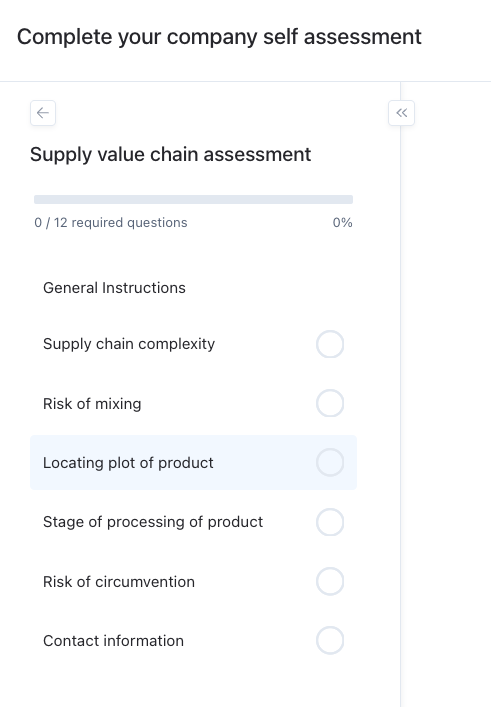
You’ll find a question asking what type of traceability system your company has implemented to identify the origin of your products. There are 5 options to select in the Coolset app.
Following this you will be asked how your traceability system works in practise. Your answer helps determine how well your current system meets EUDR traceability requirements - specifically, whether your materials can be traced back to compliant plots of land.
The screenshot below shows how these questions appear in the app:
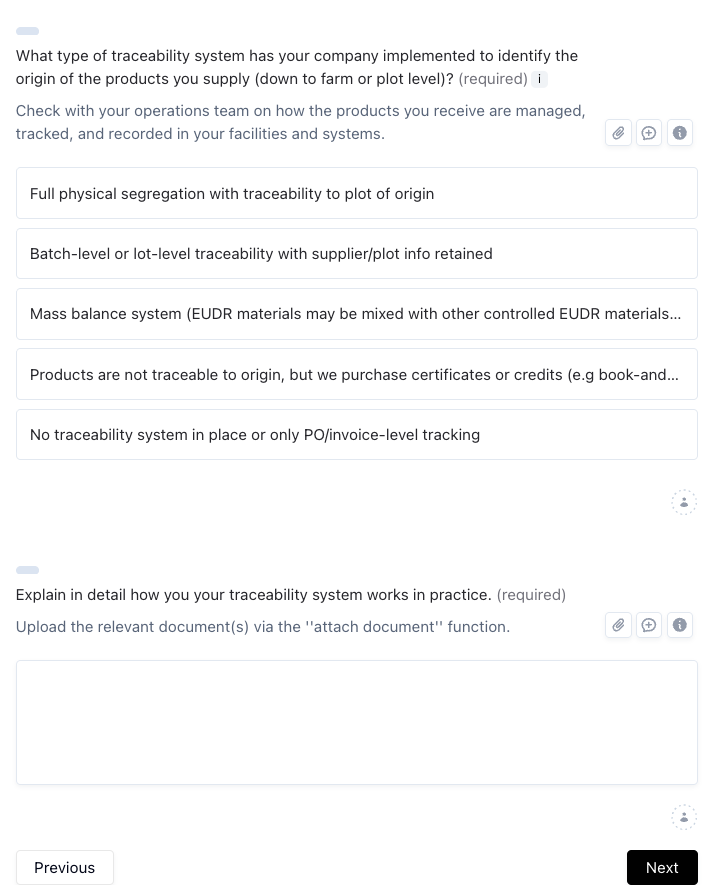
These questions cover the EUDR traceability obligation: the ability to prove, with data and documentation, that every product entering the EU market is traceable to a deforestation-free, legally sourced plot of land.
Which Traceability system is best?
For EUDR compliance, systems that allow direct traceability to the plot of land, such as Identity Preserved or Segregated, are preferred. Mass Balance may be accepted only when accompanied by strong supporting evidence of deforestation-free sourcing. Book and Claim systems cannot demonstrate compliance because they lack a physical trace to origin.